Public Art Comes to Life at PARC Campus
June 2026
Art sculptures have become essential elements in the design of modern public spaces. Beyond their artistic value, they contribute to placemaking, cultural identity, visitor engagement, and the overall experience of parks and landscaped environments.
An integral aspect of the overall design of PARC Campus is the integration of six significant, site specific public artworks. Thoughtfully placed throughout the grounds, the artworks contribute to a dynamic, interesting, and enjoyable experience that encourages exploration and reflection.
The artworks commissioned for PARC Campus were chosen for their contribution to building a sense of community and creating opportunities to gather, converse and interpret cultural and environmental stories. Collectively and individually, the artworks bring cohesion to the purpose of the building, its architecture, and the landscape design. Additionally, the artworks showcase and support the breadth and creativity of artistic practices across the Province of British Columbia.
LIVING COLLECTION, Jill Anholt, British Columbia
Jill Anholt’s art piece entitled “Living Collection,” takes inspiration from museological vessels used to hold once living species throughout history. The sculptural work stands 4.8 metres (16 feet ) tall and is intended to be entered. Once inside, the viewer can look up and see themselves reflected within the work and as a part of it. The elegant sculptural shape of this larger-than-life vessel is not held separate and protected from the natural world, but rather is open and continuous with it from all sides.
“Living Collection” is highly visible from afar, creating a beacon that helps identify PARC Campus as a place of collection, observation and study. Up close, the artwork allows visitors an opportunity to experience a different world view: the possibility of imagining themselves as part of this collection rather than only passive observers of it. By creating an opportunity for engagement and interaction, Anholt explains “This sumersive artwork invites us to reflect on our relationship to those collections, and on our human connections with the natural world around us.”
The sculpture material is Corten Steel. It is a warm brown-orange colour that will visibly change over time as it is exposed to the natural environment. The sculpture is situated on the south-east corner of the building, visible from Metchosin Road.
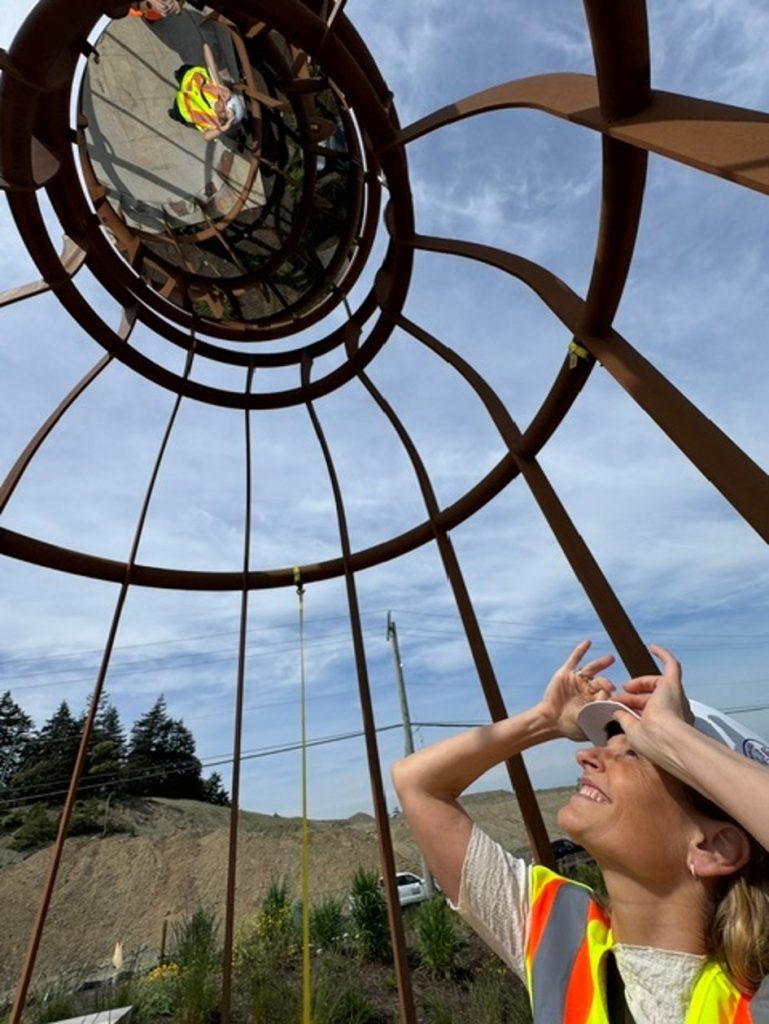
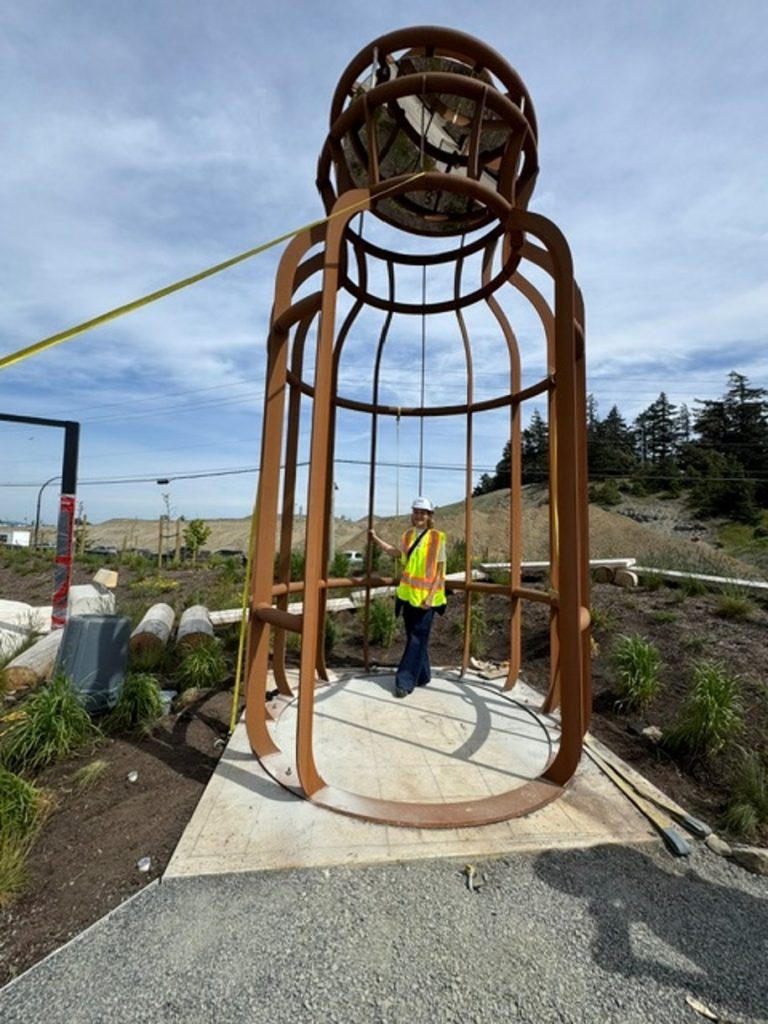
On installation day, the artist looks up into the mirror to test the desired reflection effect.
RECONCILIATION POLE, Dylan Thomas (Qwal’thilum), Lyackson First Nation
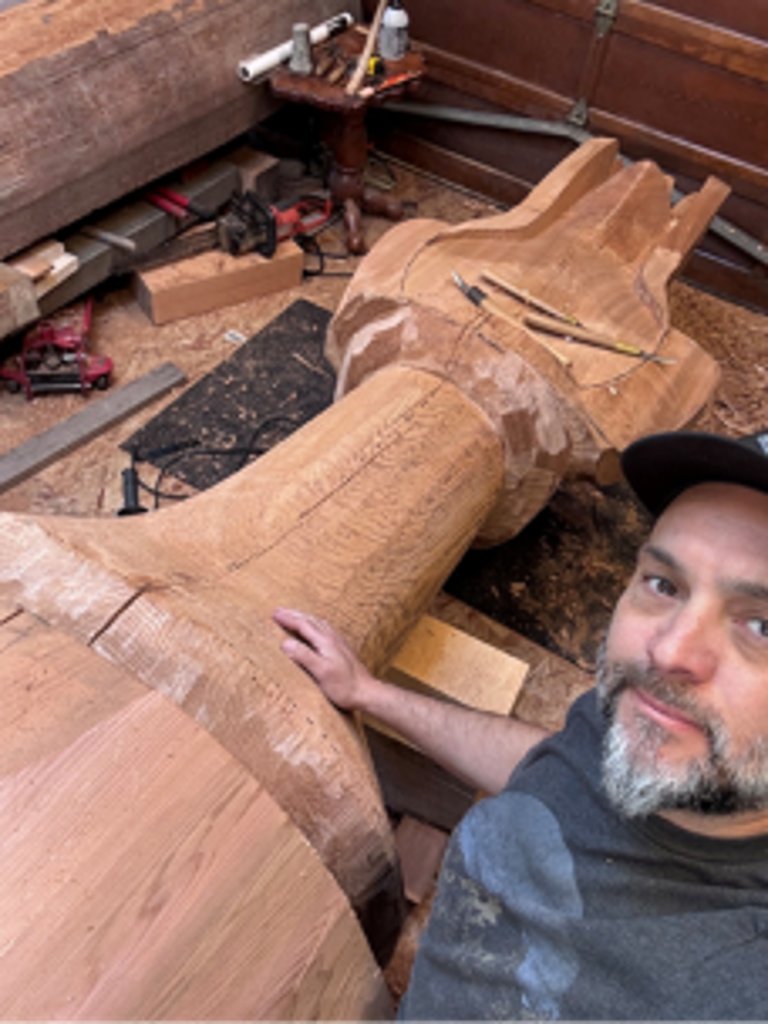
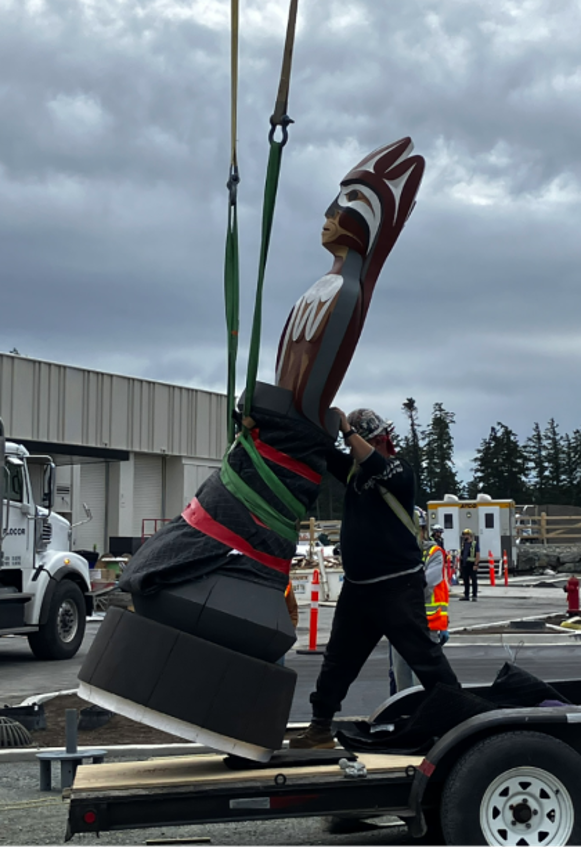
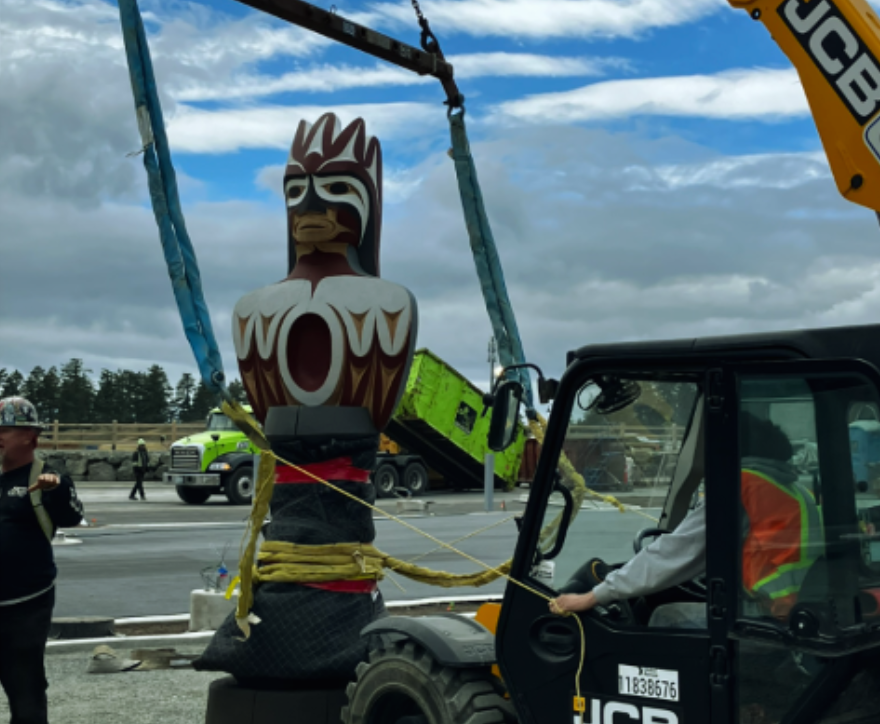
Thomas’s Reconciliation Pole drew inspiration from the renaissance period of Northwest Coast Indigenous art and culture in the 1940s to the ‘60s, when many Salish artists used museum collections and archives to study the artwork of their ancestors. In Thomas’s words, “Despite the serious issues with how many of these objects were obtained – these institutions offered a window into the rich material culture that had been deprived from Indigenous communities for decades. So, to symbolize modern indigenous communities and their resilient efforts to recover and revitalize Indigenous arts and culture, I carved a human that is transforming into a Raven, who has his claws on the lid of the box – ready to release the art, culture, and wisdom back into the world.”
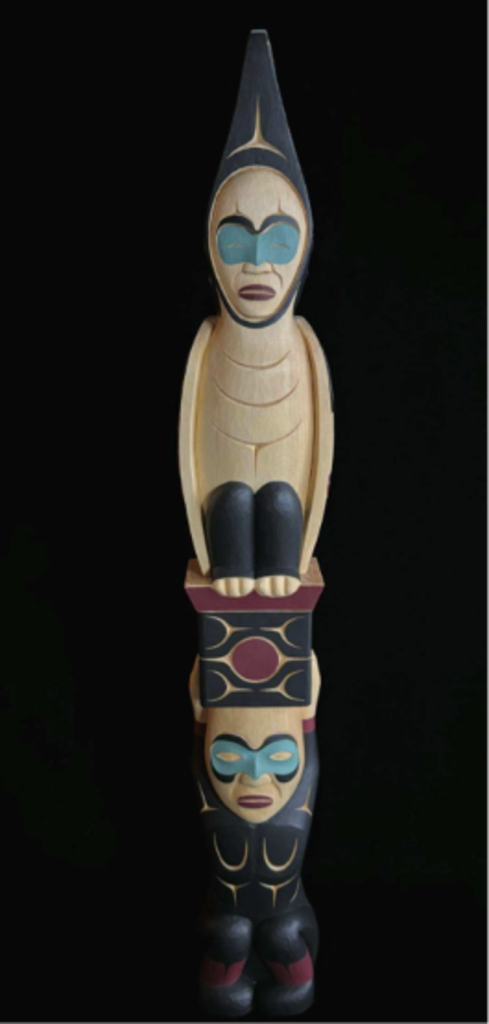
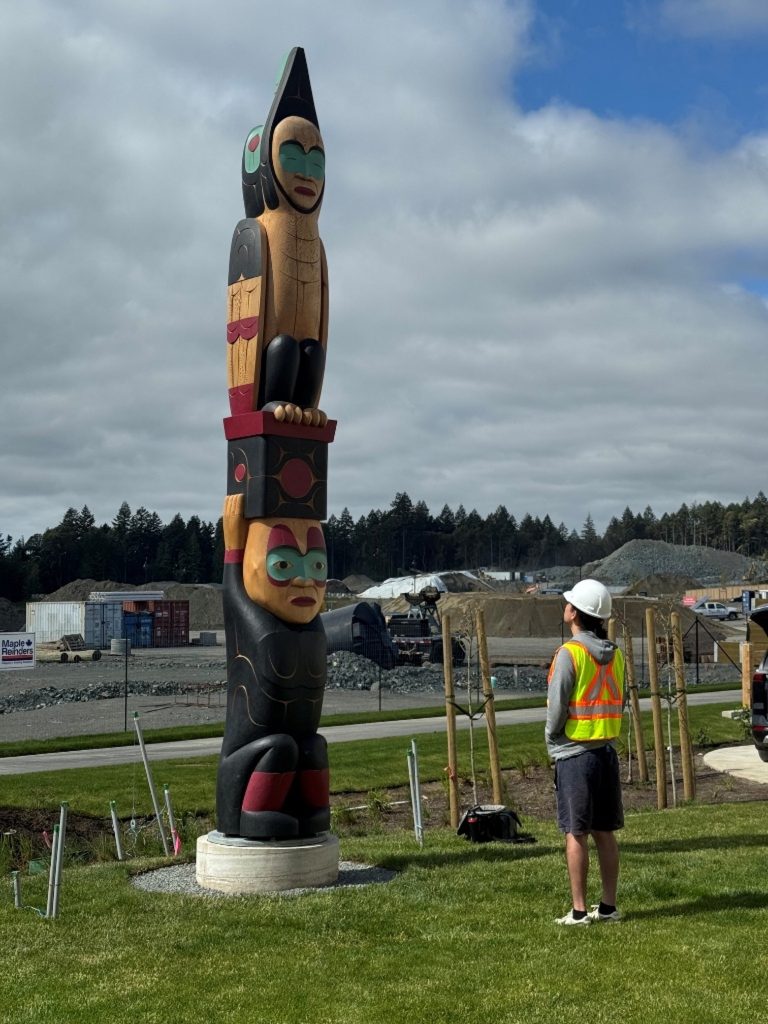
Thomas has depicted his ancestors (bottom figure) passing knowledge to contemporary indigenous communities (top figure) through museums and institutions (the box) in order to preserve Indigenous knowledge during the dark decades when his culture was being supressed.
In traditional Lekwungen stories, the Raven is often associated with stories of transformation. Thomas has depicted a human/raven to represent and encourage changes in the relationship between Indigenous and non-Indigenous communities from one of exploitation to one of mutual respect and friendship. The Raven’s head is facing upwards towards the sky, ready to take flight, symbolizing the infinite possibilities that this new relationship has to offer.
The pole is carved out of salvaged old-growth Western red cedar and stands 5.5 metres (18 feet) tall. The pole is painted in three traditional colors of the region: black, red and green. The Reconciliation Pole stands on the south side of the property and is visible from Metchosin Road.
DAY PORTAL (Our Ancestors Meeting), Charles Campbell
Campbell’s “Day Portal” considers the spiritual life of the materiala in the provincial collection, and people’s relationships to them. The Royal BC Museum’s collection spans centuries and documents the changing landscape, plant, animal life and cultures that call this place home.
In the artist’s words, “Day Portal (Our Ancestors Meeting) revolves around the connections to the past carried by this collection and how these meet us, and each other, in the present. It proposes a place where multiple experiences, histories, cultures and relationships come together, a place where we can see the past and present, the momentary and the eternal as an irreducible singularity.”
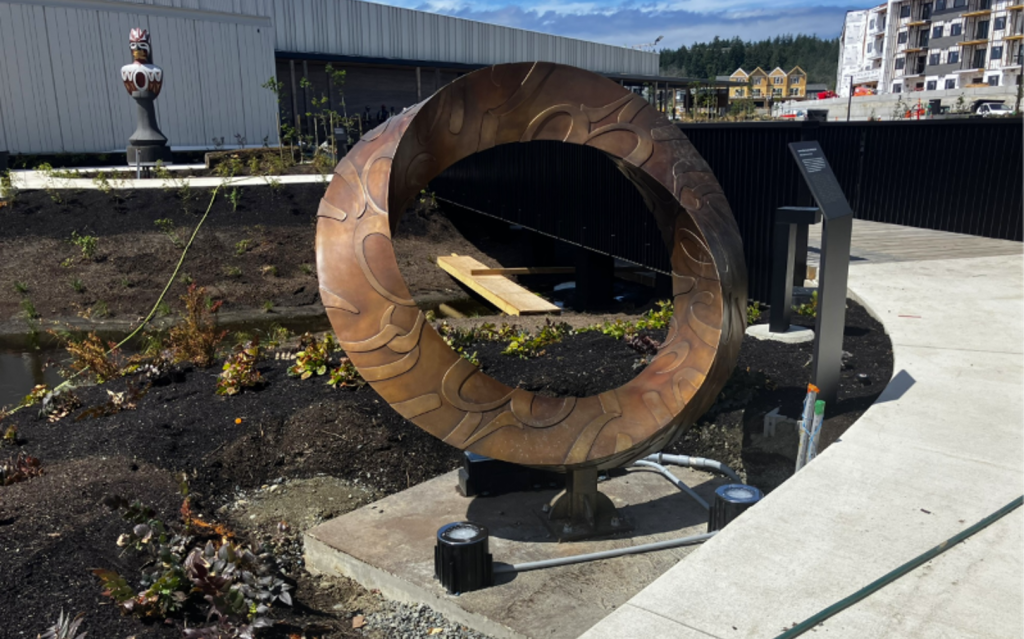
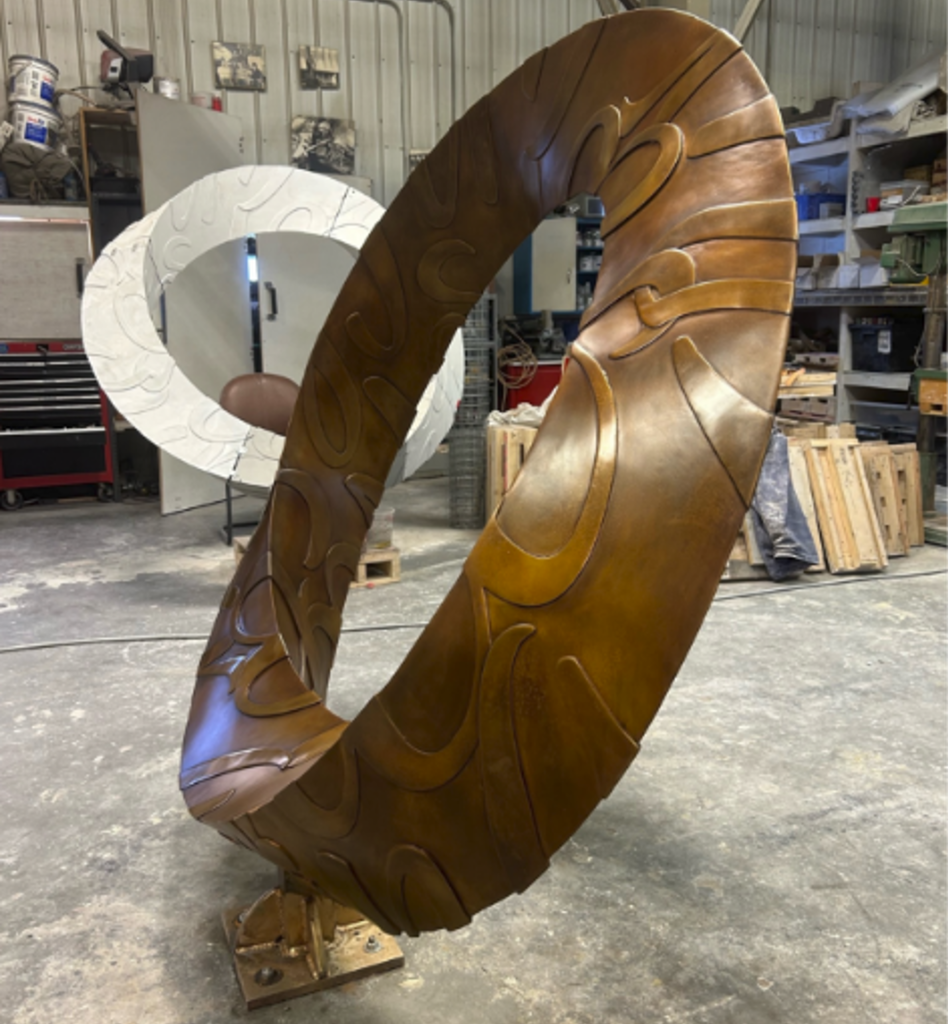
The sculpture takes the form of a three sided Mobius, a ring of a triangular section, that reveals itself to be one continuous curving plane. Text extruded from the surface encircles the form with each word wrapping around the corners. They spell out the phrase “our ancestors meeting,” or alternately “meeting our ancestors,” in a continual loop. Central to the work is the idea that we carry our ancestors with us, and that their spirits infuse the land and all we touch.
A SALISH STORY, Kwatleematt (Jane Marston) and Satuts Stsuhwum (Angela Marston) Stz’uminus (Chemainus) First Nation
The designers of the PARC Campus building created the opportunity to integrate a mural into the steel façade. Master carvers Kwatleematt and daughter Satuts Stsuhwum were asked to create the imagery for the mural.
The mural that the Marstons created tells a compelling story of the Coast Salish peoples, with traditional symbols digitized and converted into dotted patterns of bent perforations in the metal panels, creating a modern artistic response. In Kwatleematt’s words, “Traditional symbols are extremely important and necessary, but we must dream new dreams and invent new art that speak to us in our present day.”
The symbols used to tell the story include: camas flowers, welcoming figure, baskets of camas bulbs, wild cherry bark, butterflies, an octopus, the wolf, eagle and octopus.

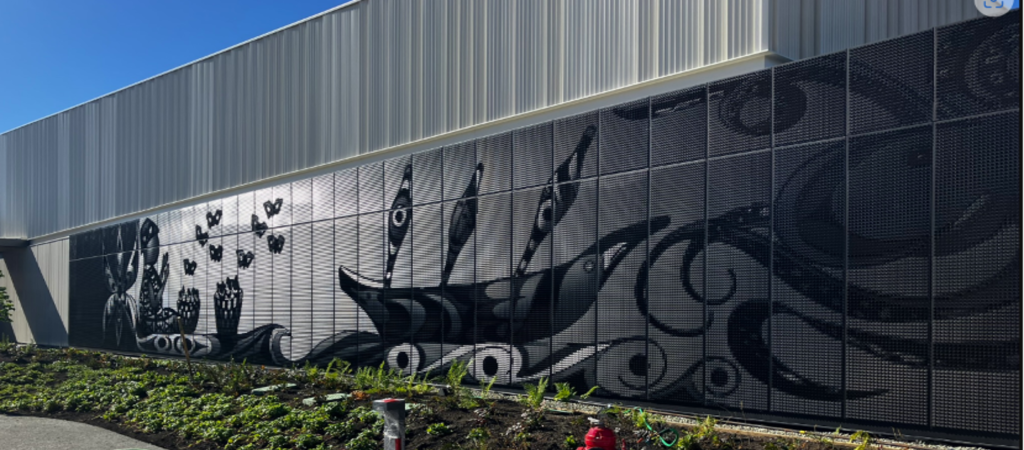
For a more in-depth description of the meaning behind the symbols, A Salish Story was featured in the February Blog here: Blog February 2026 – RBCM Collections and Research Building.
The 33 metre (108 feet) long mural is 4 metres (13 feet) high and is installed on the north side of the building facing the main entry.
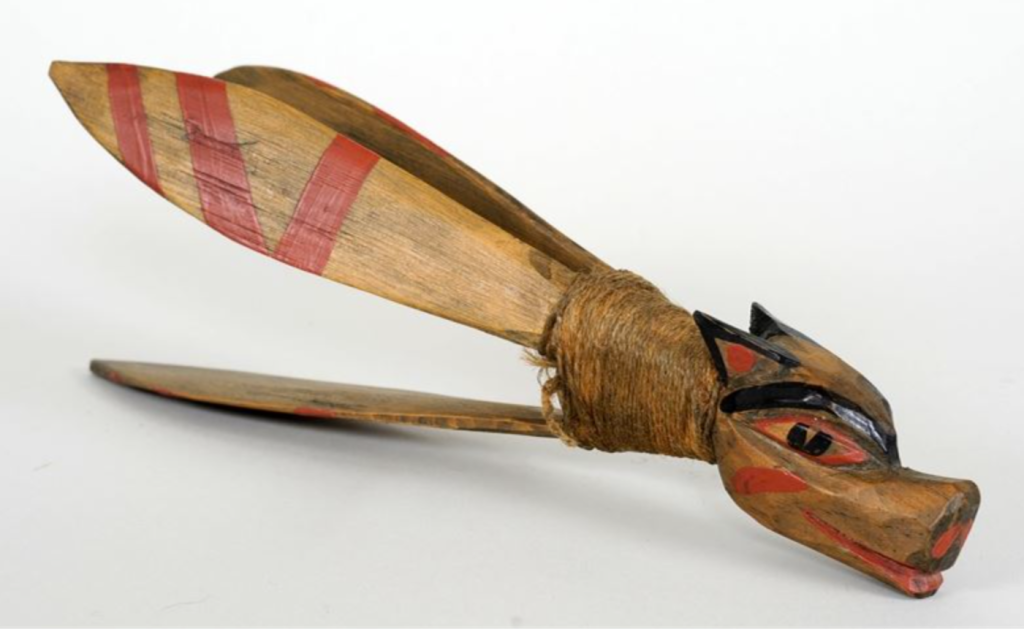
WOLF COD LURE, Ts’uts’umutl’hw (Luke Marston) Stz’uminus (Chemainus) First Nation
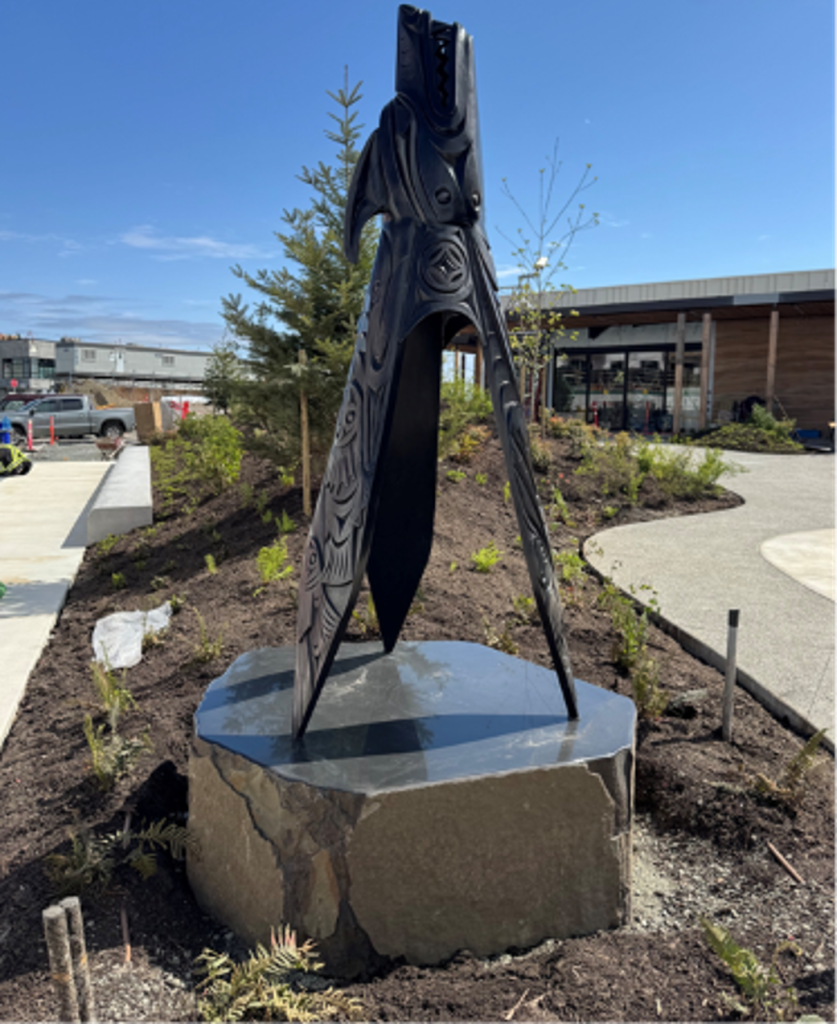
Marston’s inspiration for this piece came from the knowledge that his people used an old Salish technology, carved out of cedar, to catch cod by pushing the lure to the bottom of the ocean, which then slowly rose and spun, luring cod to the surface. Fishermen would be waiting with spears and gaffs to catch the cod. The wolf/orca transformation story comes from the local area where the PARC Campus now sits. It is carved throughout this piece along with cod designs and waves.
The sculpture is cast bronze and rests upon a large basalt base. It can be seen near the main entrance to the PARC Campus building.
HELAS and the STAR SISTERS, Oap’u’luq, (John Marston), Stz’uminus (Chemainus) First Nation
This sculpure is inspired from ancient legends shared by the ləkʷ^ əŋən peoples: the Legend of the Star Sisters and the Legend of Camossung.
According to the story, there once were two sisters who gazed up at the night sky and wished that two of the stars would be their husbands. When they awoke, they discovered that the stars were men who had taken them up to the heavens. Soon they missed life on Earth, so they dug a hole in the sky, lowered a rope and climbed down, landing on Ñga’kun – a name derived from a Salish word for “rocks on top.”
Marston’s artwork honours this story, with Helas (the Creator) occupying the top of the carving, along with Raven and Mink. These figures are connected to the ancient past through the iconic forms of the hammer and bowl. The base is shell midden, a symbol of Salish communities’ direct connection to history and the spirit of the lands.