Building on Provincial Policy:
How the PARC Campus Supports B.C.’s Mass Timber Action Plan
March 2026
When the Province of British Columbia (B.C.) announced the Mass Timber Action Plan (MTAP) in April 2022, it set out a vision for a cleaner, more innovative, and more inclusive economy. Developed in consultation with Indigenous leaders, industry partners in the forest product manufacturing and development sector, the MTAP positions B.C. as a global leader in the use of mass timber — a renewable, low-carbon material transforming how buildings are designed and constructed.
The MTAP outlines seven action items across three key areas — develop mass timber as an innovative sector, maximize mass timber’s benefits for people, and low carbon future — with a goal of growing B.C.’s mass timber sector while advancing sustainability, job creation, and innovation. One of the MTAP’s early and central commitments is to increase the number of public-sector buildings that use mass timber. The Royal BC Museum’s PARC (provincial archives, research, and collections) Campus directly supports this commitment.
Aligning with Provincial Leadership
As a provincially funded capital project, the PARC Campus was designed to reflect the Province’s policy direction and demonstrate leadership in sustainable construction. Under the MTAP, public projects — including schools, housing, and cultural facilities — are encouraged or required to incorporate mass timber wherever feasible. This approach not only incents reduction in greenhouse gas emissions but also creates steady demand that helps expand the local manufacturing, design, and construction expertise needed to grow the sector.
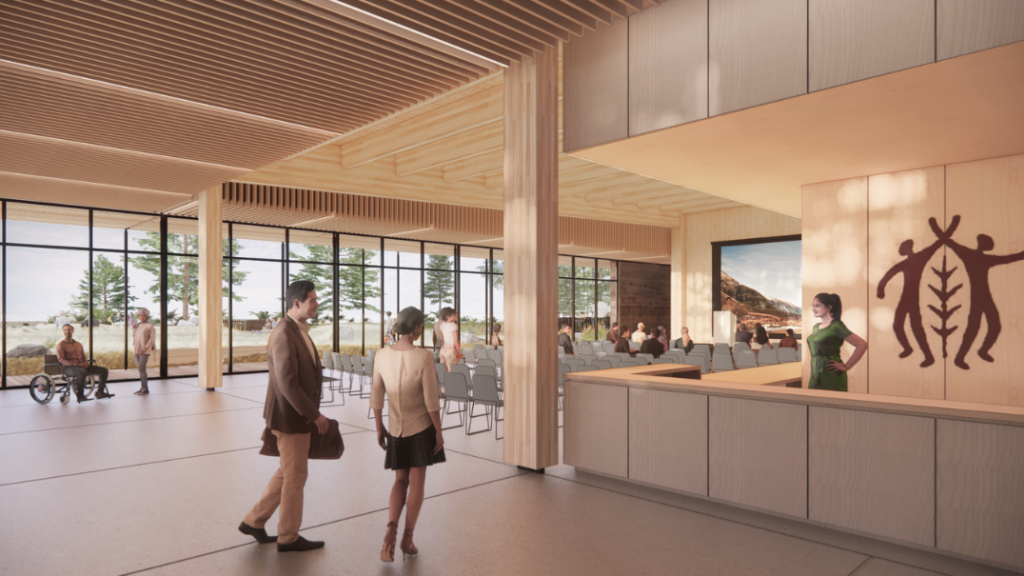
By using mass timber products, the 15,200-square-metre PARC Campus will be North America’s largest cultural building constructed primarily of mass timber. Its design exemplifies how public infrastructure can meet functional needs while contributing to a broader economic and environmental strategy.
Supporting a Stronger, Cleaner Economy
The MTAP is a cornerstone of the Province’s StrongerBC Economic Plan, which focuses on building a high-skill, low-carbon economy. As demand for mass timber grows, the sector is projected to be worth more than $400 million by 2035[1], supporting thousands of jobs across manufacturing, forestry, technology, and design.
This work is also supported through CleanBC — the Province’s plan to reduce climate-changing emissions by 40% by 2030. Under the “Building Better” category, CleanBC identifies ‘adopting mass timber products’ as a key action to reduce embodied carbon in construction, enhance material efficiency, and help transition B.C. to a cleaner economy.
By choosing mass timber, the PARC Campus contributes to this long-term growth. Each public project helps strengthen the market by providing consistent demand for products, supporting new training opportunities, and demonstrating the viability of mass timber for complex institutional buildings.
Leading the Way in Sustainable Construction
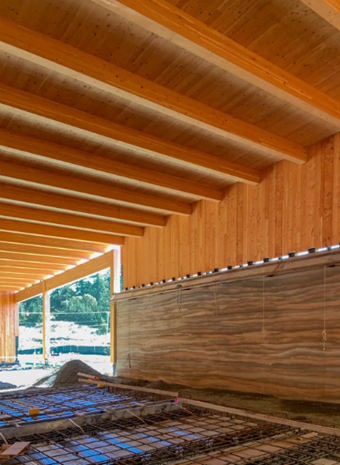
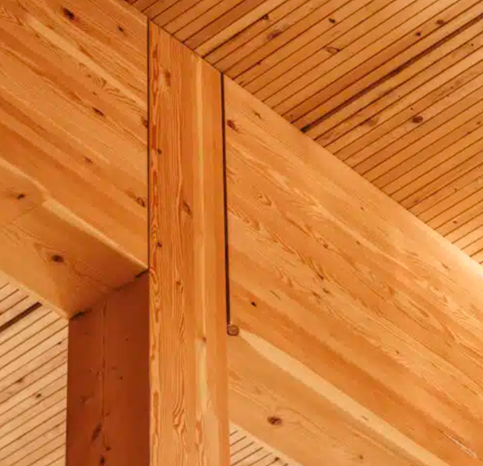
Beyond policy alignment, mass timber embodies the principles that underpin the government’s climate and innovation goals. Prefabricated timber components are manufactured off-site, minimizing waste and speeding up construction. The material’s strength, safety, and aesthetic qualities have made B.C. a North American leader — with nearly 370 mass timber buildings completed or underway by the end of 2023, more per capita than anywhere else on the continent.
The policy is targeting private sector projects next through initiatives such as the Mass Timber Demonstration Program and CleanBC Building Innovation Fund. These initiatives have provided over $7 million in funding since 2020.
A Framework for the Future
The MTAP’s success depends on collaboration between government, industry, and public institutions. The PARC Campus stands as a tangible example of how provincial policy translates into practice — advancing environmental objectives, supporting innovation in construction, and creating enduring benefits for British Columbians.
As mass timber transitions from niche to mainstream, projects like the PARC Campus illustrate the role that public investment and leadership play in building a more sustainable future — one that’s rooted in B.C.’s forest heritage and driven by clean-growth innovation.
[1] B.C.’s Mass Timber Action Plan, Page 11, 2022