Surpassing Conventional Building Design:
How the PARC Building Protects BC’s Irreplaceable Collections
April 2026
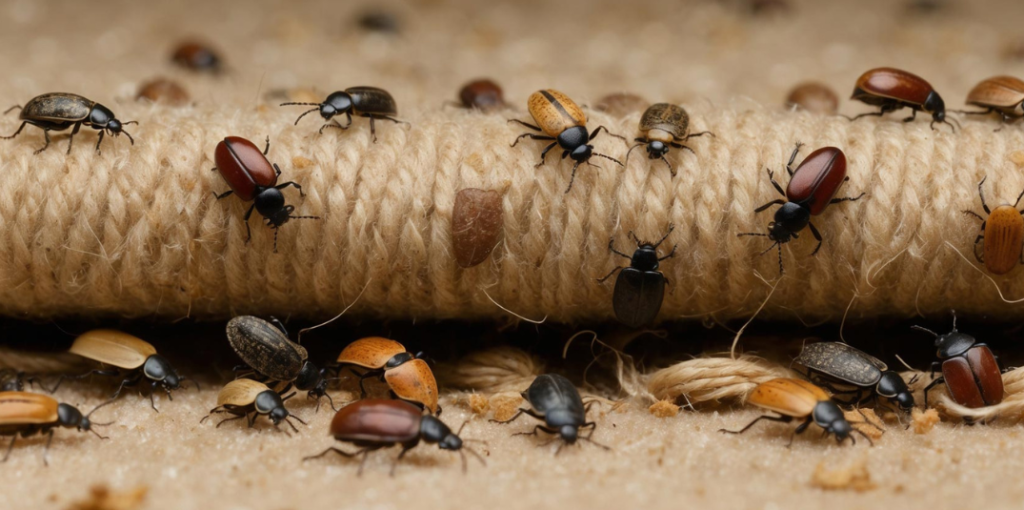
The Royal BC Museum’s vast collections include over 7 million artifacts and specimens that represent the stories, knowledge, and cultural memory of generations—and protecting them demands far more than conventional building design. The PARC building embodies a meticulous and thoughtful approach to preservation, where every wall, system, and material serves a purpose: to safeguard irreplaceable artifacts from light, moisture, temperature fluctuations, pests, fire, and water.
Sunlight Protection
Typically, architects strive to maximize daylighting in buildings to create healthier environments for people, as well as use free light for energy savings. Unfortunately, in addition to visible light, sunlight also contains ultraviolet (UV) and infrared (IR) light which can irreversibly damage the delicate items in the collections. While sunlight can’t be completely eradicated, the PARC building uses a couple strategies to reduce the impact:
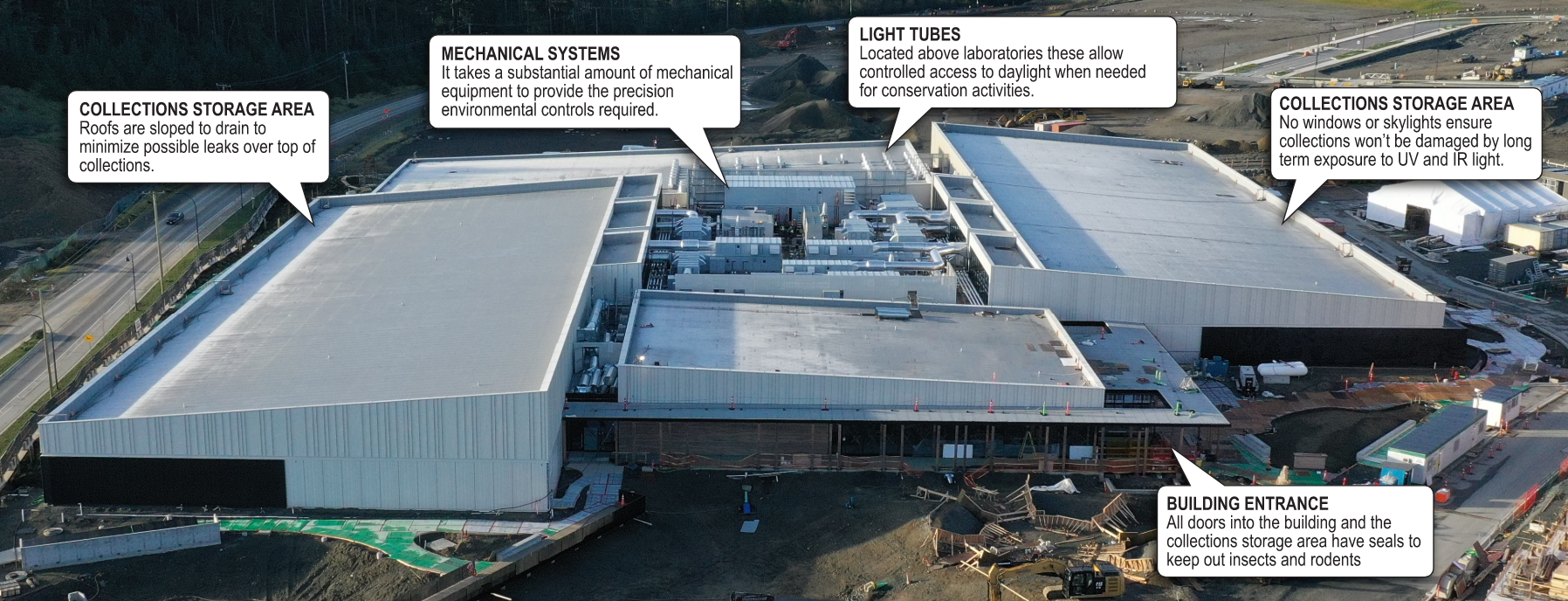
- Window Locations – The best way to protect historical artifacts from sun damage is to keep the sunlight out. In addition to not having any windows in the collections storage areas, the most sensitive spaces have entries with two doors which allows one door to be always closed when people move to and from the daylit public spaces.
- UV and IR Filters – Sunlight can’t be completely avoided because access to natural light is important for the well-being of the staff who work in the building. Natural light is also required for some restoration tasks such as colour matching. To minimize the effects, special films are applied to exterior glass to filter out UV light and reflect the heat from IR light.
Humidity Management
In our homes, we have systems that can maintain heat levels, but very rarely do we worry about controlling humidity (the amount of moisture in the air) because people can be comfortable with a broad range of humidity levels. But for collections items, small changes in humidity can cause major damage.
- Too much moisture in the air can cause items like paper and canvas to ripple, metals to rust, bones to warp, and anything organic could grow mold.
- Too little moisture can cause items like bones to become brittle, fabrics to shrink, paint colours to fade, or even cause glass to look cloudy.
- Frequent changes between high and low humidity can cause irreparable damage and deformation, especially in items made of multiple materials — like leather‑and‑wood drums.
To prevent this, the building at PARC uses dedicated equipment that adds or removes moisture from the air to keep humidity as stable as possible near 50%.
Temperature Control
Typically, building systems accommodate temperatures that keep humans comfortable in jeans and a t-shirt between 22°C and 27°C, however these temperatures can rapidly increase deterioration in artifacts. The PARC building uses several temperature control strategies to help minimize any potential degradation:
- Colder Temperatures – Most collections storage areas at PARC are kept between 16°C and 20°C. If walking around, that’s generally still comfortable for people, but the staff working there will likely need a sweater.
- Freezing Temperatures – Some items like film strips can degrade even faster at higher temperatures, so they need to be stored in freezing temperatures as low as –18°C. At that temperature, staff will need winter jackets and gloves to work in these spaces, or risk getting frostbite.
- Stable Temperatures – Similar to humidity, temperatures need to be stable to reduce the risk of damage to items that expand and contract with heat. Keeping the temperatures within a narrow range means the mechanical systems must run more often which increases energy use. At PARC the exterior walls have more insulation so changing temperatures outside have less impact, reducing how often the mechanical systems need to run. The equipment used is also highly efficient, so when the system is on, it uses less energy. This helps keep the collections comfortable and makes the building more sustainable.
Pest Prevention
It’s not uncommon to find an insect or two at home, but they’re easy to see and quick to remove if needed before a full infestation mounts.
However, with more than 7 million items distributed across thousands of cabinets in the collections storage areas, it would be nearly impossible to visually inspect for insects — so the best strategy to avoid infestation is to prevent them from entering in the first place.
The building uses several layers of defense:
- Weather seals – Commonly used on exterior doors, weather seals not only block wind and rain but also close off little holes that insects can crawl through. In most buildings that’s enough, but at PARC, there are also weather seals leading into all the collections storage areas, creating a second barrier inside the building.
- Quarantine -A dedicated “dirty entry” for new collection items. These items are quarantined and placed in built-in freezers large enough to fit a pick-up truck. Keeping the items at freezing temperatures for two weeks or more stops insect activity and makes it easier to remove them.
- Waste management – All kinds of pests like insects and small rodents are attracted to garbage. The PARC building has processes in place to minimize the waste it produces, however it can’t all be avoided. For this reason, the garbage enclosure has been located far away from the building. Unfortunately, staff must walk farther to take out the trash, but it reduces the risk of insects crawling in when the doors are open.
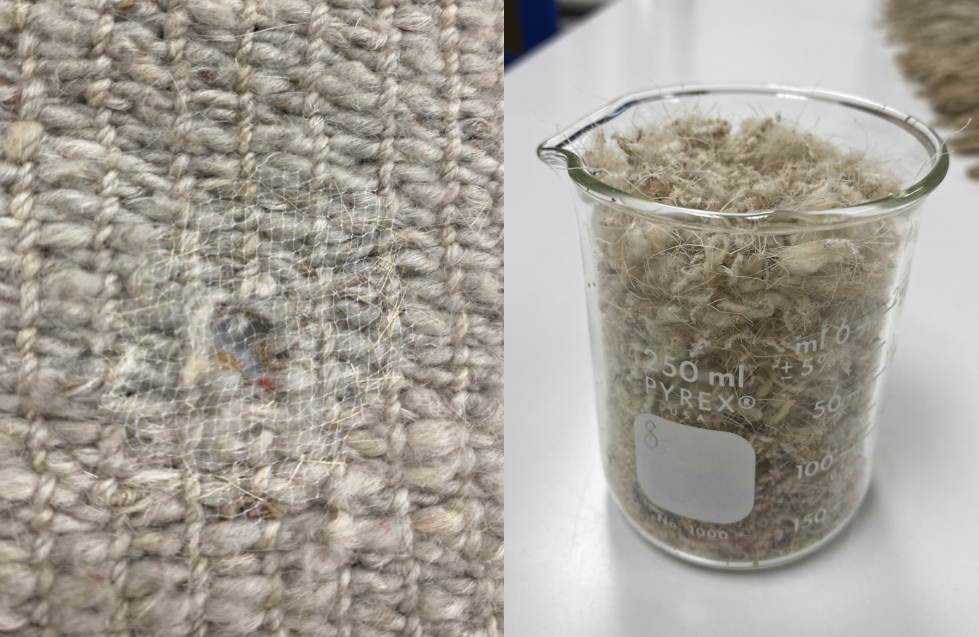
LEFT: This wool blanket shows damage caused by the common clothes moth (Tineola bisselliella). In their larva stage, these moths feed on animal‑based fibers like wool, alpaca, and rabbit fur because they contain the proteins the larvae need to build their cocoons. Since the eaten fibers can’t be replaced, museum conservators added a mesh patch to cover the hole. This helps stabilize the damaged area and keeps the sweater from unraveling.
RIGHT: A 250 ml (1 cup) beaker filled with moth cocoons that have been removed from woolen items. Most of the time, the cocoons are empty, but sometimes the larva are still inside because they died before they could turn into moths!
Fire Protection
Typical fire protection strategies focus on preventing fire from spreading within the building to allow ample time for people to evacuate safely. Moving the collections though, would take months of careful planning to safely pack and transport everything. The PARC building has therefore been designed to include additional protection to minimize flammability and fire spread
- Interior Walls – In most public buildings there are interior walls designed to prevent fire from spreading by using materials that take a long time to burn. Most commonly these walls will contain a fire for one or two hours. At PARC, the walls separating the collections spaces from the rest of the building will prevent fire from burning through for up to four hours.
- Exterior Walls – Very few buildings are concerned with fire getting in from outside the building since there’s usually time for people to get out and away. Since there isn’t time to move the collections, the exterior walls at PARC are designed to keep fire out for up to an hour, giving fire crews extra time to get the fire away from the collections.
- Sprinkler System – Sprinkler systems are required for a building of this size, and the PARC building has over 6.4km (4mi) of piping just for sprinklers. Unfortunately, the water from sprinklers could cause a lot of damage to the collection’s items. Keep reading below to find out how the sprinkler system used at PARC reduces the risk of water damage.
Water Protection
Water can permanently damage many artifacts, so the building was designed to eliminate several common water-related risks.
- Flooding from outside – Some of the current collections storage areas at the downtown site are in a basement below ground and below sea level. Combining that with how close the building is to the harbour, and you have a high risk of flooding due to rising sea levels and storm events. The new location places the building over 44m (144’) above sea level, greatly reducing flood risk.
- Groundwater seepage – Groundwater seepage is a risk within basements even when they are above sea level and even a small amount of water seepage can impact humidity levels and encourage mold growth. At the new building all collections’ storage is above grade, eliminating this risk completely
- Roof leaks – The building uses a high‑quality roofing system reviewed and guaranteed by the Roofing Contractors Association of BC but even with a high-quality installation, roof drains always create week points. The PARC building has been designed to remove this risk by sloping the roofs above the collections storage areas, directing the water away from the collections and draining it off to the side.
- Sprinklers – When a standard sprinkler system detects a fire somewhere in the building, the sprinkler piping is flooded with water, and the sprinkler heads release it immediately throughout the entire building no matter where the fire is located. At the PARC building, when a fire is detected, the sprinkler pipes in the collection’s areas will fill with water, but the sprinkler heads won’t release it until they detect high enough temperatures to indicate the fire is in the room. This reduces the risk of items being damaged by water unless it’s necessary.
Conclusion
By integrating state‑of‑the‑art building science with a deep respect for the past, PARC ensures these collections will remain intact, accessible, and inspiring for decades to come. It’s more than a storage facility—it’s a promise to future generations that our shared history will be preserved with the care and attention it deserves.
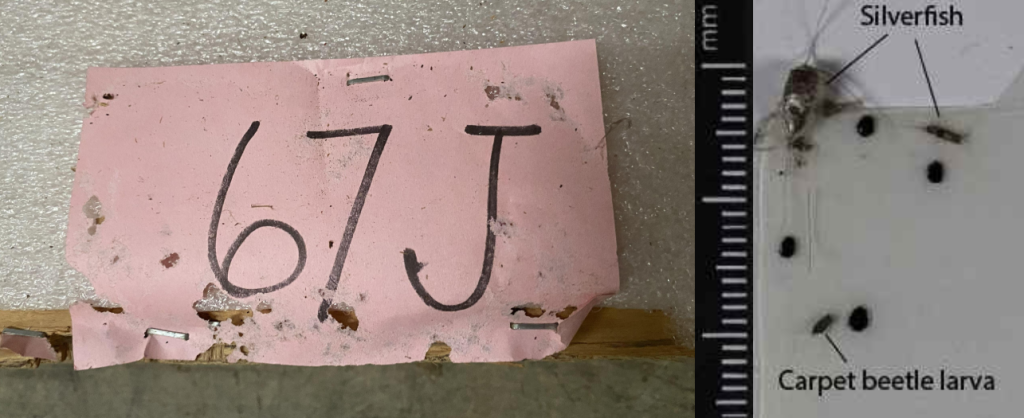
LEFT: This damaged paper label shows the characteristic bite marks left by silverfish (Lepisma saccharina). These insects, commonly found in household washrooms, feed on cellulose which is a key component of plant-based fibers like wood, cotton and hemp. Although this label could be replaced, damage like this to historic documents, artworks, or books is irreparable.
RIGHT: Silverfish and Carpet beetle larva caught in a sticky trap that conservators at the museum use to monitor how many bugs are getting into collections spaces.